

DMARC analyzer: Identify email threats and unauthorized senders
Sendmarc’s DMARC analyzer collects and interprets authentication results to show exactly who’s sending emails from your domain – and whether those messages pass or fail checks. The DMARC reporting tool flags unauthorized senders, uncovers phishing attempts, and helps you enforce DMARC policies confidently, without risking legitimate email flow.
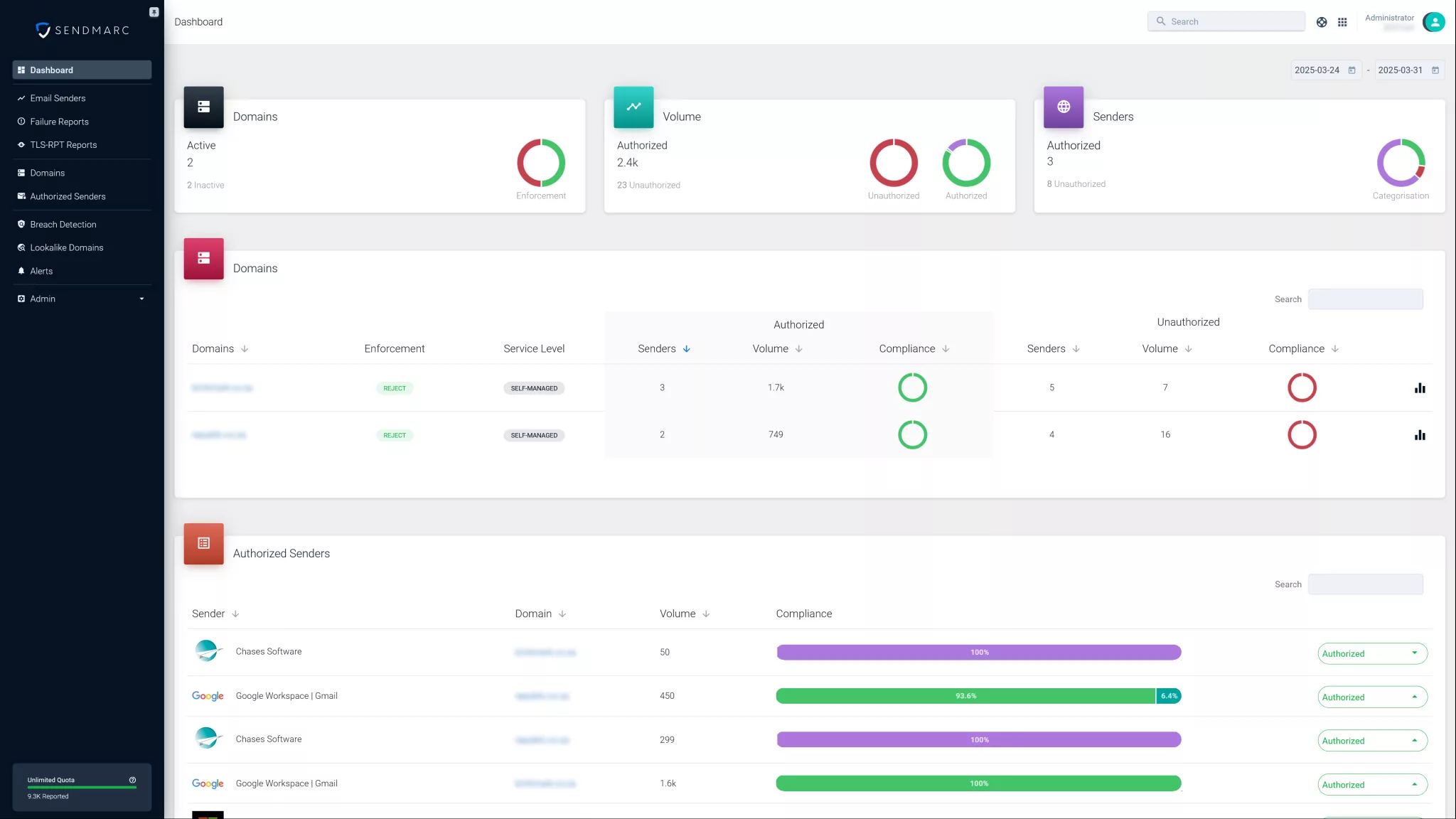
Use real data to secure your domain faster.
What is a DMARC analyzer?
Email impersonation continues to be one of the most common and effective tactics used in phishing attacks. While implementing Domain-based Message Authentication, Reporting, and Conformance (DMARC), Sender Policy Framework (SPF), and DomainKeys Identified Mail (DKIM) is crucial, these protocols alone aren’t enough. Monitoring DMARC reporting is essential to maintaining domain security and email integrity.
A DMARC analyzer is a specialized reporting and monitoring tool that helps organizations understand DMARC data and improve their email security strategy. It provides detailed reporting, threat analysis, and actionable insights that help secure domains and improve email deliverability.
By using a DMARC reporting tool, businesses gain the visibility and control needed to make informed decisions. This feature simplifies complex DMARC reports and turns them into clear next steps. The tool helps to:
- Identify all entities sending emails on behalf of a domain
- Verify whether messages pass SPF and DKIM authentication checks
- Detect sources that are failing authentication, and understand why
- Progress safely toward a p=reject policy without interrupting legitimate email delivery
How a DMARC analyzer works
Understanding the DMARC protocol
DMARC is an email authentication protocol created to protect domains from unauthorized use, including phishing and spoofing attacks. DMARC works alongside SPF and DKIM to validate the legitimacy of email senders and messages.
- SPF ensures that only authorized IP addresses can send emails on behalf of a domain
- DKIM uses cryptographic signatures to confirm that email content hasn’t been altered during transit
DMARC adds an extra layer of protection by defining how receiving servers should respond when an email fails SPF or DKIM checks. Based on the domain’s policy, these actions may include marking the message as Spam or rejecting it outright. DMARC also enables domain owners to receive reports on authentication failures, providing visibility into potential cyberthreats.
Role of DMARC records
DMARC records are TXT entries published in a domain’s DNS. These records tell receiving email servers how to handle unauthenticated messages and where to send DMARC reports. Before setting up a DMARC record, domain owners must implement both SPF and DKIM. Once those are in place, a DMARC record can be created and should include the following:
- Policy (p=none, p=quarantine, or p=reject): Defines how to handle emails that fail SPF or DKIM checks
- Reporting (RUA & RUF): Specifies where to send DMARC reports
- Percentage: Shows the percentage of messages the policy should apply to
By using a DMARC reporting tool, domain owners can make sense of the data in these reports, identifying gaps in security, spotting unauthorized senders, and safely moving toward stricter enforcement without disrupting legitimate email traffic.
Benefits of using a DMARC analyzer
Implementing DMARC is a crucial step toward protecting your company’s domain, but effectively managing it requires ongoing analysis. A DMARC analyzer provides the features needed to monitor, manage, and optimize your company’s email authentication.
Improved visibility & reporting
With DMARC analysis, your organization receives comprehensive aggregate and forensic reports. These reports provide visibility into email traffic and identify potential cyberthreats. This insight allows businesses to respond proactively to email-based threats.
Simplified record management
Using a DMARC reporting tool streamlines the process of creating and maintaining a DMARC record. It reduces the risk of configuration errors and saves time by automating tasks that generally require manual DNS updates.
Enhanced compliance
An analyzer can support compliance with data protection and cybersecurity regulations by ensuring that email communications are authenticated and monitored. This helps meet standards such as the General Data Protection Regulation (GDPR) and the California Consumer Privacy Act (CCPA), which highlight the secure handling of personal data.
DMARC analyzer features
Unlike basic tools, Sendmarc’s DMARC report analyzer offers advanced features such as real-time threat detection, automated DNS updates, and enterprise-grade reporting. These capabilities enable your company to stop impersonation and maintain full control of its domain.
Real-time insights
Our DMARC analyzer provides real-time monitoring and alerts. This allows organizations to detect phishing and spoofing attempts as they happen, enabling immediate action. A proactive approach helps prevent security breaches before they cause significant damage.
Automated DNS updates
The analyzer automates DNS updates, reducing manual configuration work and minimizing the risk of error. This ensures DMARC records are accurately aligned with existing SPF and DKIM records, maintaining a secure and compliant email environment.
Enterprise-grade reports & API integration
Our DMARC analyzer provides in-depth, enterprise-grade reports that offer actionable insights into domain activity. With an API-first approach, the tool easily integrates into existing IT environments and Security Information and Event Management (SIEM) systems, strengthening businesses’ overall email security posture.
Take control of your domain security with Sendmarc’s DMARC analyzer. Gain real-time insights, simplify compliance, and stop impersonation attacks before they reach client inboxes.
DMARC analyzer: FAQs
Why do I need a DMARC analyzer?
A DMARC analyzer is essential for streamlining the implementation and ongoing management of a DMARC policy. It helps companies understand complex authentication data and identify cyberthreats. A DMARC analyzer can also provide clear, actionable insights that improve domain protection and email deliverability.
How does a DMARC analyzer work?
A DMARC analyzer works by collecting and analyzing DMARC reports sent from global email providers. These reports reveal who’s sending emails on behalf of a domain, identify failed authentication attempts, and uncover potential spoofing or phishing threats. The analyzer presents this data in a readable format, helping organizations respond quickly to cyberthreats and maintain compliance.
What are DMARC reports, and why are they important?
DMARC reports are files sent by receiving email servers that outline email authentication results.
- Aggregate reports show which servers are sending emails on behalf of a domain, whether those messages passed SPF and DKIM checks, and which domains were involved in the sending process.
- Failure reports contain details about individual messages that failed authentication.
These reports are critical for monitoring domain activity, identifying unauthorized senders, and improving overall email security.
Can DMARC reports be read without a DMARC analyzer?
DMARC reports can technically be read without an analyzer, but they’re XML-formatted and can be difficult to understand. Large volumes of reports, often sent by hundreds of email providers, make manual analysis time-consuming without specialized tools.
What features should a DMARC analyzer platform have?
A reliable DMARC analyzer should include features such as:
- Real-time reporting and threat visualization
- SPF and DKIM record management
- Easy configuration of DMARC policies
- Alerts for authentication failures
- Historical data tracking
- Multi-domain and multi-tenant support
These features help companies maintain control, ensure proper configuration, and respond to cyberthreats quickly.
Is a DMARC report analyzer useful for small businesses?
A DMARC analyzer is highly useful for small businesses. Smaller organizations are frequent targets for email-based attacks. A DMARC analyzer gives them the visibility, control, and confidence needed to protect their domain from impersonation and phishing.