

DMARC monitor: Continuous email authentication & brand protection
Sendmarc’s DMARC monitor gives your business continuous visibility into email activity, so you can spot unauthorized senders, reduce cyberthreat risk, and improve deliverability. With real-time alerts and intuitive insights, it’s the simplest way to secure your domain and protect your reputation.
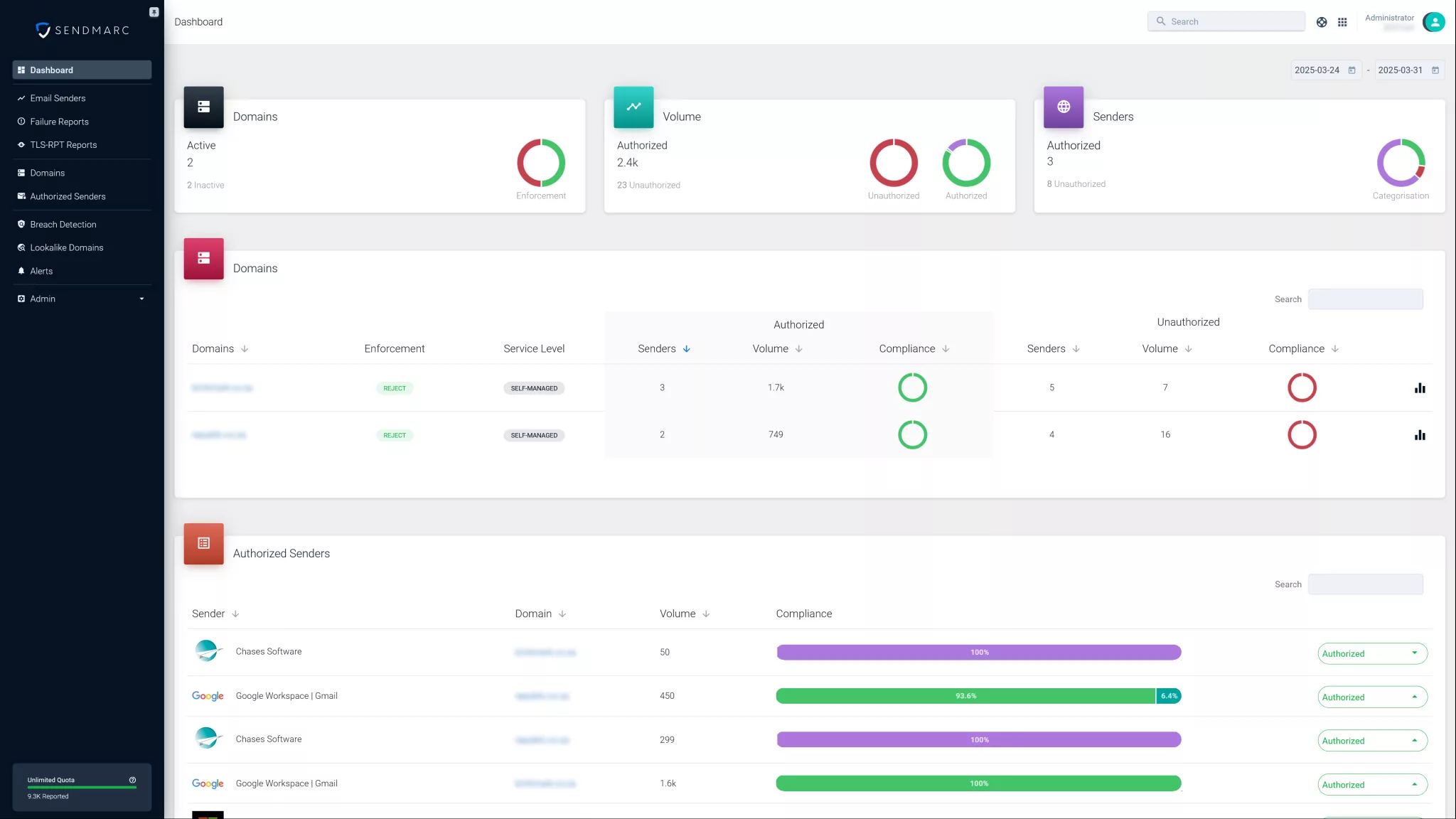
Start with Sendmarc’s DMARC monitor – no complexity involved.
What is a DMARC monitor?
A DMARC monitor is a tool that gives your company visibility into how its domain is being used to send email. It tracks authentication results, identifies unauthorized senders, and highlights configuration issues that could impact email deliverability or security.
Domain-based Message Authentication, Reporting, and Conformance (DMARC) is an email authentication protocol that builds on Sender Policy Framework (SPF) and DomainKeys Identified Mail (DKIM). It helps prevent email spoofing by verifying that messages claiming to come from your organization’s domain are legitimate.
With a DMARC monitor, your business can:
- See which emails pass or fail authentication
- Detect impersonation attempts
- Enhance email delivery
- Maintain compliance with security and privacy standards
Key terms explained:
- DMARC: Handles emails that fail SPF and DKIM checks based on the policy in place (p=none, p=quarantine, or p=reject)
- SPF: Confirms that emails come from authorized servers
- DKIM: Uses cryptographic signatures to verify the message hasn’t been altered
How a DMARC monitor works
1. DMARC record setup
Your company publishes a DMARC record in its DNS. The DMARC record defines how email receivers should handle messages that fail authentication checks and where to send reports.
2. Email authentication
When an email is sent from your organization’s domain, receiving servers check if it passes SPF and DKIM validation.
3. Report collection
Email servers generate aggregate reports (in XML format) that outline the authentication results. These reports are sent to the address specified in your business’s DMARC record.
4. Report analysis
The DMARC monitor collects and processes these reports, presenting the data in a user-friendly dashboard. Your company gets a clear view of all sources sending messages on its behalf.
5. Ongoing monitoring
The monitor continuously tracks authentication results and alerts your organization of suspicious activity. This allows for timely action and improves your business’s security posture.
Tip: Try a free DMARC monitoring solution to understand the value it offers before your company commits to the protocol.
Benefits of using a DMARC monitor
A DMARC monitor ensures:
Strengthened email security
- Detect and block phishing, spoofing, and impersonation attempts
- Identify unauthorized senders using your organization’s domain before they can cause harm
Improved deliverability
- Ensure legitimate emails reach the inbox, not the Spam folder
- Improve sender reputation and engagement rates
Enhanced compliance
- Meet requirements from email providers, governments, and regulators
- Simplify audits with centralized, clear reporting
Increased insight
- Visual dashboards turn complex authentication data into understandable reports
- Get clear recommendations for improving security
Protected reputation
- Prevent impersonation and fraudulent use of your business’s domain
- Enable BIMI to display your company’s verified logo in recipients’ inboxes
Why choose Sendmarc’s DMARC monitor?
Sendmarc’s DMARC monitor is built for organizations that want clarity, protection, and ease of use. We provide DMARC without the complexity.
Our DMARC monitor and services provide:
Complete reporting & visibility
- Real-time tracking of DMARC, SPF, and DKIM statuses
- Visual dashboards and detailed reports on all email activity
Proactive threat detection
- Instant alerts for suspicious activity
- Early identification of cyberthreats before they impact your business
Simple setup & management
- Guided configuration for DMARC, SPF, DKIM, BIMI, TLS-RPT, and MTA-STS
- Automated SPF flattening to avoid the DNS lookup limit
Automated analysis & recommendations
- Advanced processing turns raw data into actionable insights
- Smart suggestions for improving security
Expert support, always
- Access to award-winning support and expert guidance
- Personalized assistance at every stage of your company’s email security journey
Ready to take control of your email security?
Start a free DMARC monitoring trial with Sendmarc and protect with confidence.
DMARC monitor: FAQs
What is DMARC monitoring?
DMARC monitoring is the ongoing process of collecting and analyzing DMARC reports to ensure that only authorized emails are sent from your organization’s domain. A DMARC monitor helps detect phishing, stop spoofing, and improve your business’s overall email security posture.
What is a DMARC policy?
A DMARC policy is the set of instructions your company gives to receiving email servers on how to handle unauthenticated emails sent from its domain. The policy options are none (monitor only), quarantine (send to Spam), and reject (block the email).
What triggers a DMARC report?
An aggregate DMARC report is generated automatically and generally sent on a daily or weekly basis, outlining email authentication results. A failure DMARC report is triggered in real time and provides detailed information about individual messages that fail authentication.
Is DMARC really necessary?
Yes, DMARC is necessary to protect your organization’s customers, employees, and stakeholders from email-based threats like phishing and spoofing. DMARC is also required by major email providers, governments, and regulators, so it helps your business meet multiple compliance standards.
How do I interpret DMARC reports?
Interpreting DMARC reports involves reviewing data that shows who’s sending emails from your company’s domain and whether those emails passed SPF and DKIM checks. Sendmarc’s DMARC monitoring service simplifies this process by turning raw data into clear, actionable insights.